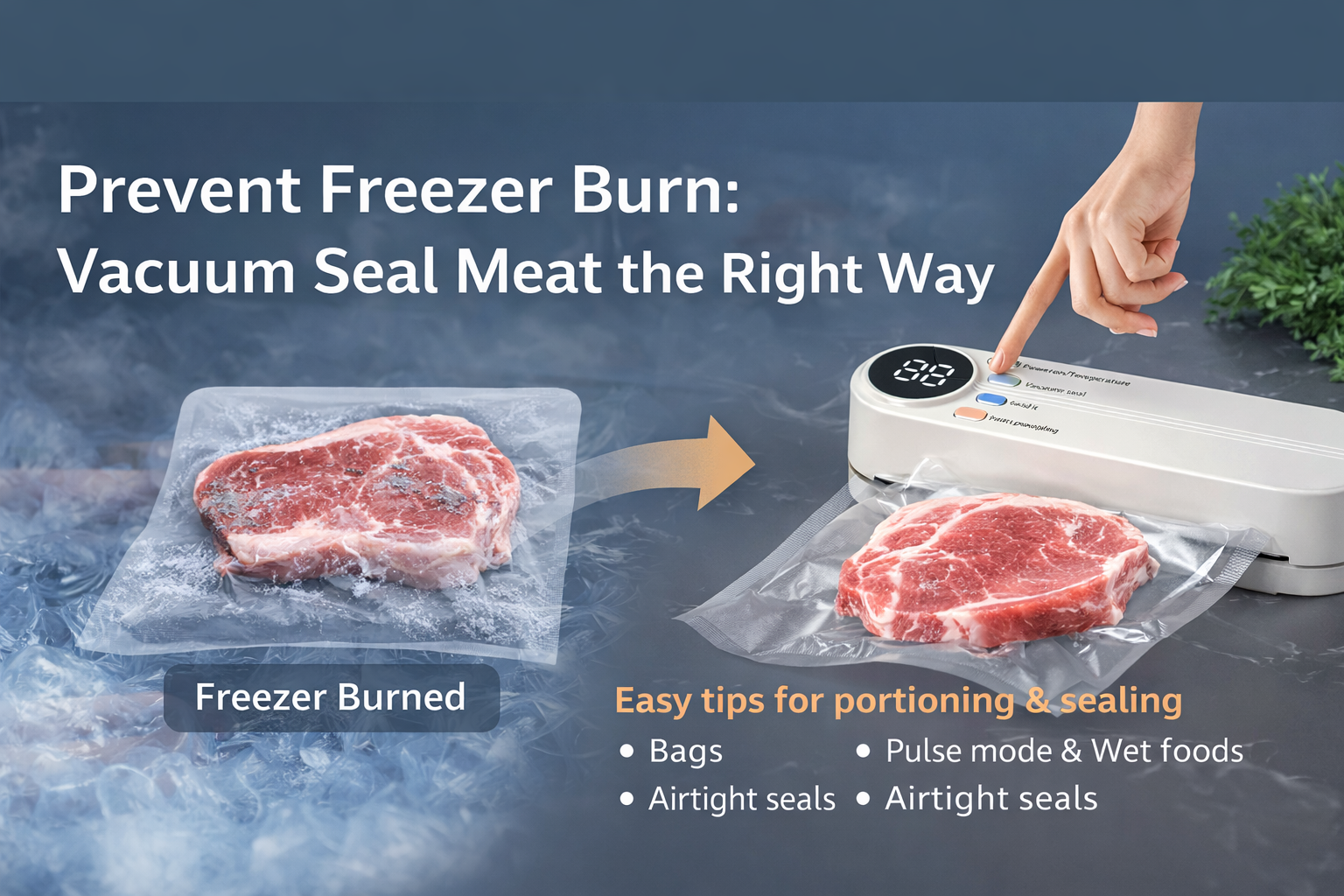
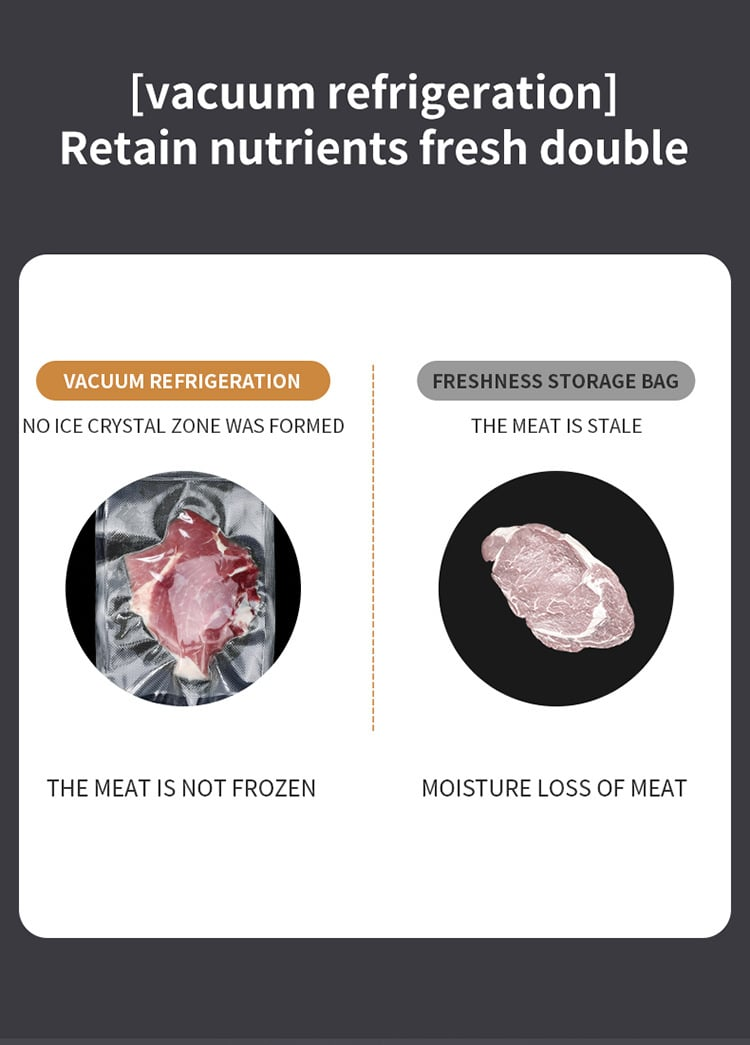
Freezer burn is the reason perfectly good meat turns dry, grayish, and bland after a few weeks. It’s not a “bad freezer” problem—it’s an air exposure problem. The good news: you can prevent most freezer burn with a simple routine that takes 15–20 minutes after your grocery run, especially if you buy in bulk or meal-prep.
In this guide you’ll learn what actually causes freezer burn, the fastest way to portion and store food, and the vacuum sealing method that keeps meat and veggies tasting closer to fresh—without turning your kitchen into a production line.
Our cordless handheld vacuum sealer is ideal for small kitchens and quick batch prep—easy to grab, easy to store, and strong enough to reduce air exposure that causes freezer burn.
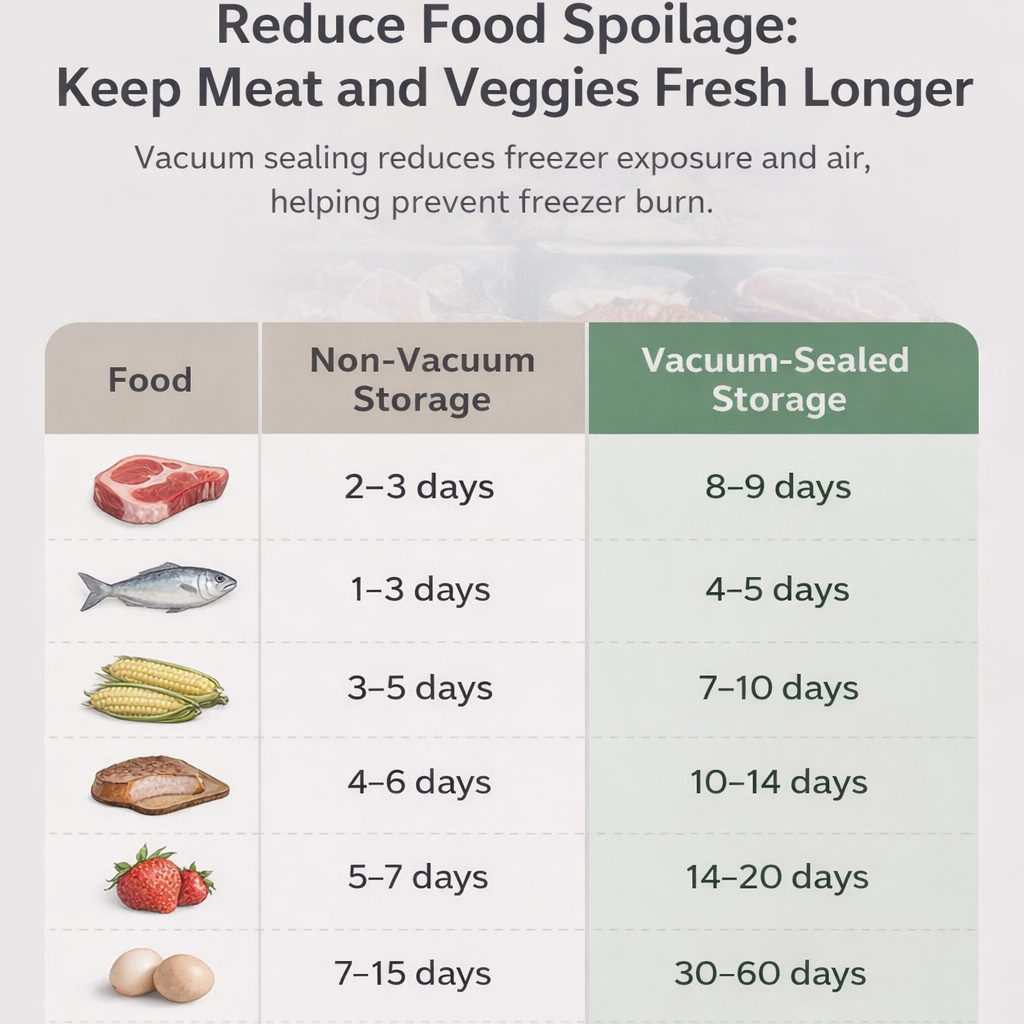
What freezer burn really is (and why it happens)
Freezer burn happens when food is exposed to air inside the freezer. The surface dehydrates, texture changes, and flavors fade. You’ll usually notice:
- Dry, tough texture after cooking
- Pale/gray patches on meat
- “Old freezer” smell or stale flavor
Most of the time, the cause is one of these:
- Too much air trapped in the bag
- Reopening the same bag repeatedly (air in, air out, again and again)
- Weak seals (especially with oily edges or wet seal lines)
- Thin packaging that doesn’t stay airtight
So the strategy is simple: portion smaller, remove air, seal clean, store flat.
The 15–20 minute routine that prevents freezer burn
1) Portion like you’ll actually cook
Don’t freeze a giant pack you’ll reopen five times. Freeze one-cook portions:
- Ground meat: 1 lb (or your usual recipe amount) per bag
- Chicken: 2–4 pieces per bag
- Fish/steaks: single portions
- Veggies: stir-fry packs, soup packs, fajita mix packs
Pro tip: flatten meat bags into a thin rectangle—faster to freeze, faster to thaw, less air pockets.
2) Pick the right bag (this matters more than most people think)
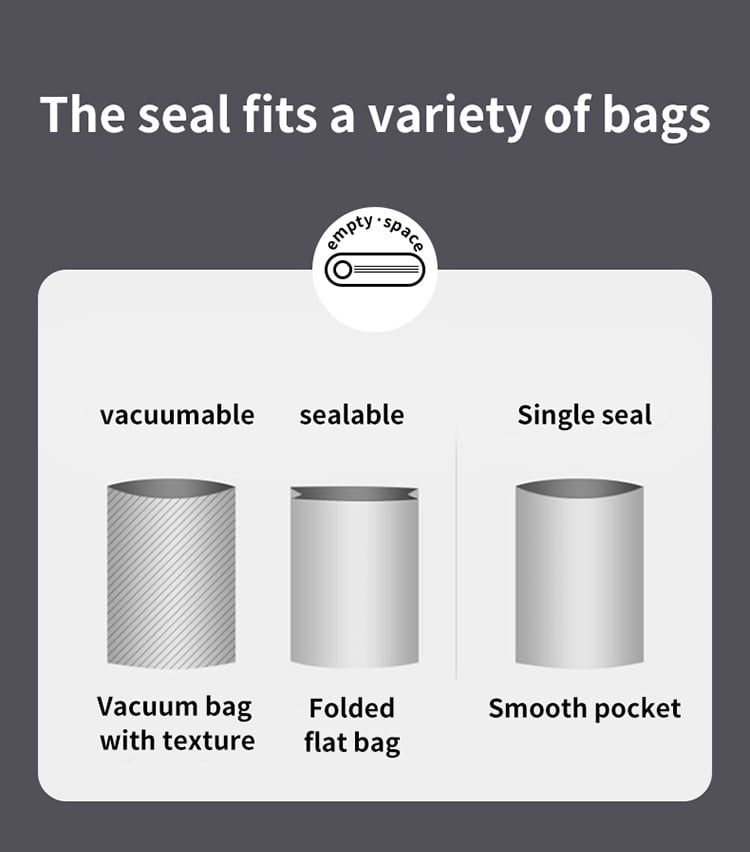
For vacuum sealing, textured/embossed vacuum bags usually give the most consistent results because the channels help air escape.
Common bag types you’ll see:
- Textured/embossed bags (recommended for vacuum): easiest, most reliable
- Flat/folded bags: can work, but not always consistent for vacuum
- Smooth bags: often best for sealing-only unless paired with a valve/container setup
The vacuum sealing method (and how to avoid seal failures)
A handheld vacuum sealer is ideal for small kitchens and quick batch prep because it’s easy to grab and store. Your device supports:
- Vacuum degree: -60 kPa (strong suction for tighter packs)
- Modes: Vacuum sealing / Single sealing / Pulse (“point pumping”)
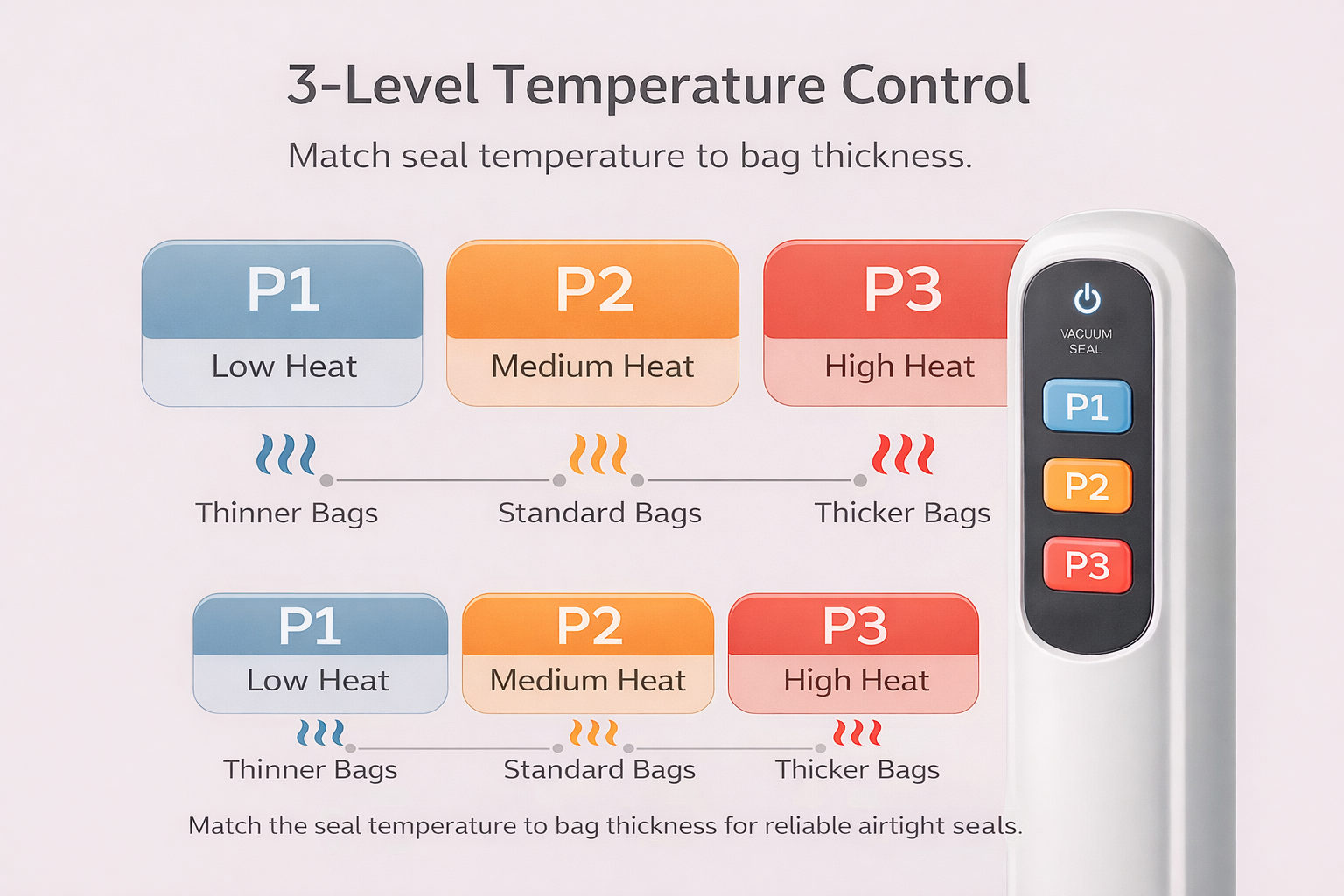
- 3 temperature levels (P1, P2, P3) for different bag thicknesses
- Sealing length: 125 mm (12.5 cm)
- Sealing width: 2.0 mm
- Cordless + rechargeable: 1200 mAh battery, 5V input
- External vacuum extraction (containers/valve bags) + external pump use cases
Step-by-step (dry foods & meat)
- Put the portion into the bag and keep the top area clean and dry
- Leave enough headspace (don’t stuff it to the edge)
- Run vacuum, then seal immediately
- Check seal line: it should look smooth and continuous
- Label + date, then freeze flat
Choose P1 / P2 / P3 the simple way
- P1: thinner bags (avoid melting/wrinkling)
- P2: standard bags (most common)
- P3: thicker bags (stronger heat to ensure a tight seal)
If you see bag warping → lower the level. If you see weak seals → raise the level.
The #1 beginner problem: sealing wet or marinated foods
Wet foods are where freezer burn prevention often fails—not because vacuum sealing doesn’t work, but because liquid creeps toward the suction area.
Two fixes solve this almost every time:
Fix A: Pre-freeze for 30–60 minutes
Place marinated meat, soups, berries, or saucy portions in the freezer briefly until the surface firms up. You don’t need it rock solid—just stable enough that liquid won’t rush forward.
Fix B: Use Pulse (point pumping)
Pulse removes air in short controlled bursts so you can stop before liquid reaches the opening, then seal.
This is exactly what your Point Pumping / Pulse function is for.
Storage upgrades that also reduce odor transfer
Vacuum sealing doesn’t just prevent freezer burn; it also helps reduce odor transfer because items are sealed instead of open to the freezer environment. On top of vacuum bags, your unit supports external vacuum extraction, which is useful for:
- Vacuum containers (berries, salads, leftovers)
- Valve zipper bags (travel snacks, short-term fridge storage)
Insert image here: [Image 5 – “Multiple external connections / External vacuum extraction”]
Caption: External vacuum extraction works with compatible containers/valve bags for fridge storage and leftovers.
Alt text: External vacuum extraction for containers and bags.
Quick checklist: freezer burn prevention in 60 seconds
If you only remember one thing, remember this:
- Portion into one-cook packs
- Use the right bag (textured bags = easiest)
- Keep the seal line clean and dry
- Use the correct seal temperature (P1–P3)
- Pre-freeze + Pulse for wet foods
- Freeze flat, label, and rotate (FIFO)
FAQ
Is -60 kPa suction strong enough?
For home meal prep and freezer storage, it’s solid. The bigger difference is bag choice + sealing technique, and Pulse mode for wet foods.
What bags does it work with?
Textured vacuum bags are the most consistent for vacuum sealing. It can also do sealing-only on various bags, and external extraction on compatible valve/container setups.
How wide can it seal?
Sealing length is 125 mm (12.5 cm), so choose bag openings that fit within that width.
How do I stop seal failures?
Most failures come from moisture/oil at the seal line or using the wrong temperature. Wipe the bag edge, leave headspace, and adjust P1–P3.
Is it portable?
Yes—compact size 164 × 43 × 56 mm, cordless 1200 mAh, 5V input charging makes it practical for small kitchens, RV, travel, and camping prep.
Product spec (for readers who want the details)
- Product: Mini cordless handheld vacuum sealing machine
- Vacuum degree: -60 kPa
- Input: 5V / 2A, power 10W
- Seal length: 125 mm, seal width 2.0 mm
- Modes: Vacuum / Seal / Pulse (point pumping)
- Temperature: P1 / P2 / P3
- Battery: 1200 mAh
- Size: 164 × 43 × 56 mm
- Extra: External vacuum extraction + external pump use cases
Ready to stop freezer burn?Shop the cordless handheld vacuum sealer.